Why US Companies Are Betting Big on Wroclaw as Their European Retail Launchpad

If you've been watching where savvy American retailers are planting their European flags lately, one name keeps coming up: Wroclaw. Tucked in southwestern Poland, this city of around 640,000 people doesn't always make the headlines that Paris or Amsterdam do — but when it comes to setting up a lean, efficient, and strategically placed commercial operation in Europe, it's quietly become one of the continent's best-kept secrets. And it's not staying secret for much longer.
Location, Location, Location — But Make It Continental
American businesses entering Europe typically wrestle with a familiar dilemma: do you anchor in Western Europe for brand prestige, or do you go where your logistics actually make sense? Wroclaw offers a compelling third option — a city close enough to Germany's industrial heartland (Dresden is roughly 90 miles away) while sitting at the crossroads of major Central European trade routes.
The A4 motorway, which slices across southern Poland and connects directly into the German autobahn network, runs right through the Wroclaw region. Add to that a modernized international airport with growing cargo capacity, and direct rail freight connections into Western European markets, and you've got a distribution setup that can realistically reach 350 million European consumers within a 24-hour delivery window. For US retailers managing regional fulfillment operations, that kind of reach from a single hub is genuinely hard to beat.
The Cost Equation That's Turning Heads
Let's talk numbers, because this is where Wroclaw really separates itself from the pack. Commercial real estate in Wroclaw runs at a fraction of what you'd pay in comparable Western European logistics corridors. Warehouse and distribution space in the greater Wroclaw area typically comes in at rates 40 to 60 percent below equivalent facilities in Germany or the Netherlands — and that gap becomes even more dramatic when you compare it to UK or Scandinavian markets.
Labor costs tell a similar story. Poland's workforce is well-educated, multilingual, and increasingly experienced in international supply chain operations. Wages remain meaningfully lower than in Western Europe, which gives US companies a significant margin advantage when staffing fulfillment centers, customer service operations, and regional retail management teams. Several major American logistics firms have already built out substantial presences here specifically because the math just works.
Beyond the headline numbers, Poland's EU membership means US businesses operating out of Wroclaw get full access to the single market without the regulatory headaches that come with non-EU locations. VAT frameworks, customs procedures, and trade documentation all operate within the familiar EU structure — a huge simplification compared to managing multi-jurisdiction compliance from scratch.
What's Actually Being Built on the Ground
Wroclaw's commercial real estate market has been on a serious growth trajectory over the past decade, and the development pipeline reflects genuine confidence from international investors. The Bielany Wrocławskie logistics zone, located just outside the city proper, has emerged as one of Central Europe's most active commercial development corridors. Major international property developers have been snapping up land and building out modern, spec-built warehouse and light industrial facilities designed specifically with international tenants in mind.
These aren't the crumbling post-communist sheds you might picture — we're talking about BREEAM-certified green buildings with automated sorting systems, EV charging infrastructure, and office-grade amenity spaces integrated into the warehouse footprint. The kind of facility that an American operations director from, say, a mid-size DTC brand or a specialty retailer would recognize immediately as fit for purpose.
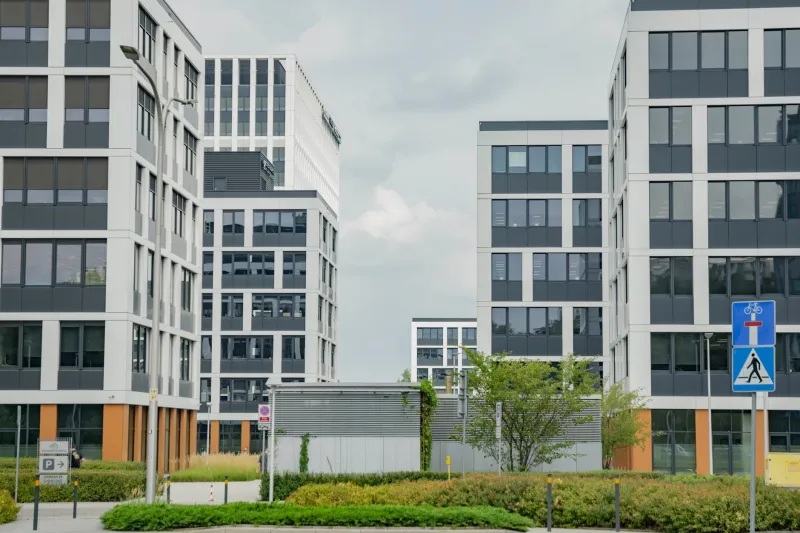
Retail-facing commercial development has been equally impressive. New mixed-use schemes combining retail, office, and last-mile logistics space are reshaping the city's commercial geography, creating a more sophisticated environment for brands that want both a distribution backbone and a consumer-facing presence in the Polish market.
The Talent Pipeline Is Real
One factor American executives consistently cite after spending time in Wroclaw is the quality of local talent. The city is home to Wroclaw University of Technology and several other major academic institutions, producing thousands of graduates annually in engineering, logistics, business, and IT. The result is a labor market with genuine depth in exactly the skill sets that modern retail and distribution operations require.
English proficiency is high by Central European standards, which matters enormously for US companies managing regional operations from stateside headquarters. You're not navigating language barriers at every turn — your local management team can genuinely plug into your broader corporate communications without friction.
What This Means for the Wroclaw Commercial Property Market
For anyone tracking commercial real estate in the region, the influx of international tenants is creating real momentum. Vacancy rates in prime logistics zones have been tightening steadily, and rental values — while still favorable compared to Western Europe — have been trending upward as demand outpaces new supply in the most desirable locations.
That means the window for securing premium space at today's rates may not stay open indefinitely. US companies that have already moved are benefiting from early-mover advantages in terms of both pricing and site selection. Those still evaluating their options should be aware that the competitive landscape for the best Wroclaw commercial properties is intensifying.
For American retailers and logistics operators looking to establish a European foothold that's cost-efficient, strategically positioned, and genuinely future-ready, Wroclaw deserves a serious look. The city isn't just a cheaper alternative to Frankfurt or Rotterdam — it's increasingly a first-choice destination in its own right.