Smart Money Abroad: Why American Expats Are Quietly Stacking Commercial Real Estate Deals in Wroclaw

Ask most Americans where they'd park money in European commercial real estate, and you'll hear the usual answers: a storefront in Lisbon, a retail unit in Prague, maybe something near a tourist corridor in Vienna. Wroclaw, Poland rarely makes that first-instinct list — and that's exactly why the Americans who've already moved here are so enthusiastic about it.
This southwestern Polish city, sitting at the crossroads of Central Europe's most active logistics and retail corridors, has been quietly building a reputation among US expats as one of the most financially sensible places on the continent to own commercial space. The reasons aren't exotic or complicated. They're just math — and a tax code that happens to work unusually well for Americans doing business abroad.
The Price Gap That Stops Americans in Their Tracks
Let's start with the number that tends to end conversations about Western Europe. Prime commercial retail space in central Wroclaw currently runs somewhere in the range of €1,500 to €2,500 per square meter to purchase outright — depending on location, building age, and foot traffic. Compare that to equivalent properties in Munich (€8,000–€12,000), Amsterdam (€7,000–€10,000), or even Warsaw's most competitive districts, and you start to understand why the spreadsheets look so different here.
For an American expat who's already relocated to Europe — maybe following a spouse's work assignment, maybe retiring early, maybe just done with the US cost of living — that gap represents real leverage. You can acquire substantially more usable retail or office space in Wroclaw for the same capital outlay, which changes the entire risk profile of an investment.
"I came here initially for my wife's job at a tech company," says Marcus, a former commercial broker from Denver who now owns two small retail units near Wroclaw's Świdnicka Street corridor. "I wasn't planning to buy anything. But when I ran the numbers against what I'd been looking at in Berlin, it felt almost irresponsible not to move on something here."
How Polish Tax Structure Plays Into the Expat Equation
Poland's commercial real estate tax environment has some features that are particularly relevant for American investors, especially those who've structured themselves correctly before making a move.
Poland operates a flat corporate income tax of 19% for standard businesses, with a reduced rate of 9% available for smaller companies meeting certain revenue thresholds. For Americans setting up a Polish limited liability company (sp. z o.o.) to hold commercial property, this creates a clean, relatively low-friction structure that's easier to report back to the IRS under FBAR and FATCA requirements than equivalent structures in countries with more complex tax treaties.
Poland and the United States have a bilateral tax treaty in place that prevents double taxation on most categories of income, including rental income from commercial properties. That matters enormously for expats who are still filing US returns — which, as any American living abroad quickly learns, is a lifelong obligation regardless of where you actually live.
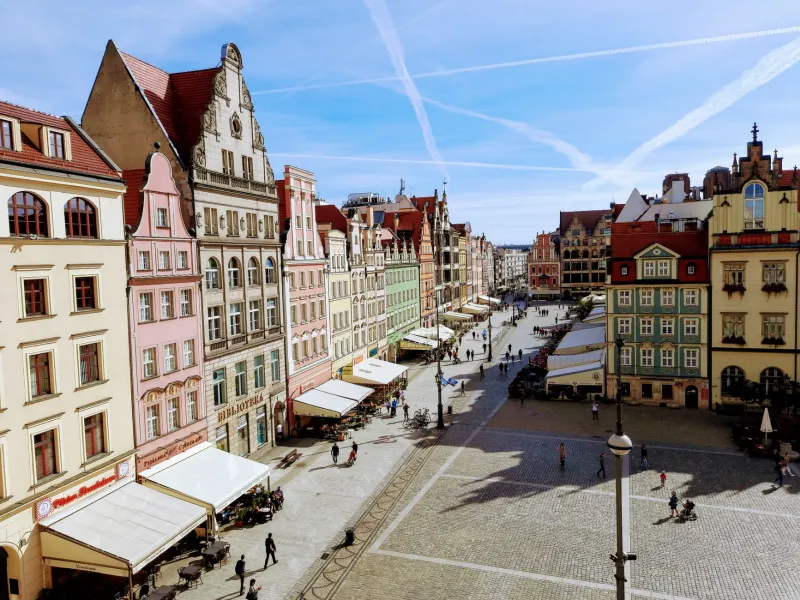
"The treaty coverage was honestly the first thing I researched," says Jennifer, a former retail operations manager from Atlanta who now leases out ground-floor commercial space in a renovated building near Wroclaw's Market Square. "I needed to know that whatever I earned here wasn't going to get taxed twice. Poland was one of the cleaner situations I found."
Beyond income tax, Poland's VAT reclaim process for business property purchases — while not simple — is navigable with local accountancy support, and several Wroclaw-based firms now specifically cater to English-speaking foreign investors.
The EU Passport for Your Business
One angle that doesn't get discussed enough in US financial media is what owning commercial real estate inside the European Union actually means for business flexibility. A retail unit or commercial premises in Wroclaw isn't just a Polish asset — it's an EU-footprint asset, which carries implications for distribution, hiring, and cross-border e-commerce operations that American entrepreneurs are increasingly aware of.
With Poland's position as one of Central Europe's primary logistics hubs — and Wroclaw specifically sitting near major road and rail connections to Germany, Czech Republic, and beyond — commercial space here functions as a gateway rather than just a local play.
Tyler, who relocated from Chicago and now operates a small import-focused retail concept out of a commercial unit in one of Wroclaw's newer mixed-use developments, puts it plainly: "I'm not just selling to Wroclaw. I'm selling to Central Europe. The address just happens to be here, and the overhead is a fraction of what I'd pay to operate out of Frankfurt."
What the Due Diligence Actually Looks Like
For Americans considering this path, the process isn't without friction. Polish property law requires a notarized purchase agreement, and while foreign nationals can legally purchase commercial real estate without special permits (residential property has different rules), working with a bilingual notary and a local legal advisor is strongly recommended.
The Wroclaw commercial property market also moves at a different pace than US real estate — transactions tend to take longer, bureaucratic processes require patience, and building inspection standards differ from what Americans are used to. Several expats interviewed for this piece mentioned that having a trusted local contact — whether a property manager, a Polish business partner, or a relocation specialist — was the single most important factor in making the process workable.
That said, the infrastructure for foreign investors in Wroclaw has grown noticeably over the past several years. English-language property listings are more common, international law firms have opened Wroclaw offices, and the city's Special Economic Zone status for certain development areas creates additional incentive layers worth exploring.
The Quiet Momentum Building Here
What's interesting about the American expat community in Wroclaw's commercial real estate scene isn't the volume — it's still a relatively small group — it's the consistency of the story. People arrive here for one reason, notice the property economics, and end up staying longer than planned.
Wroclaw has a young, educated population, a growing tech and services sector, and a retail culture that's evolving rapidly as Polish consumer spending power rises. The city's commercial spaces — from renovated tenement storefronts to purpose-built retail parks — are filling up with a mix of international brands and local concepts, which keeps vacancy rates relatively healthy and rental yields competitive.
For Americans already living in Europe and looking for a place to put investment capital to work, the question is increasingly less why Wroclaw and more why did it take this long to find it.
The deals are here. The tax framework is workable. And the Americans who got in early are, by and large, not complaining.